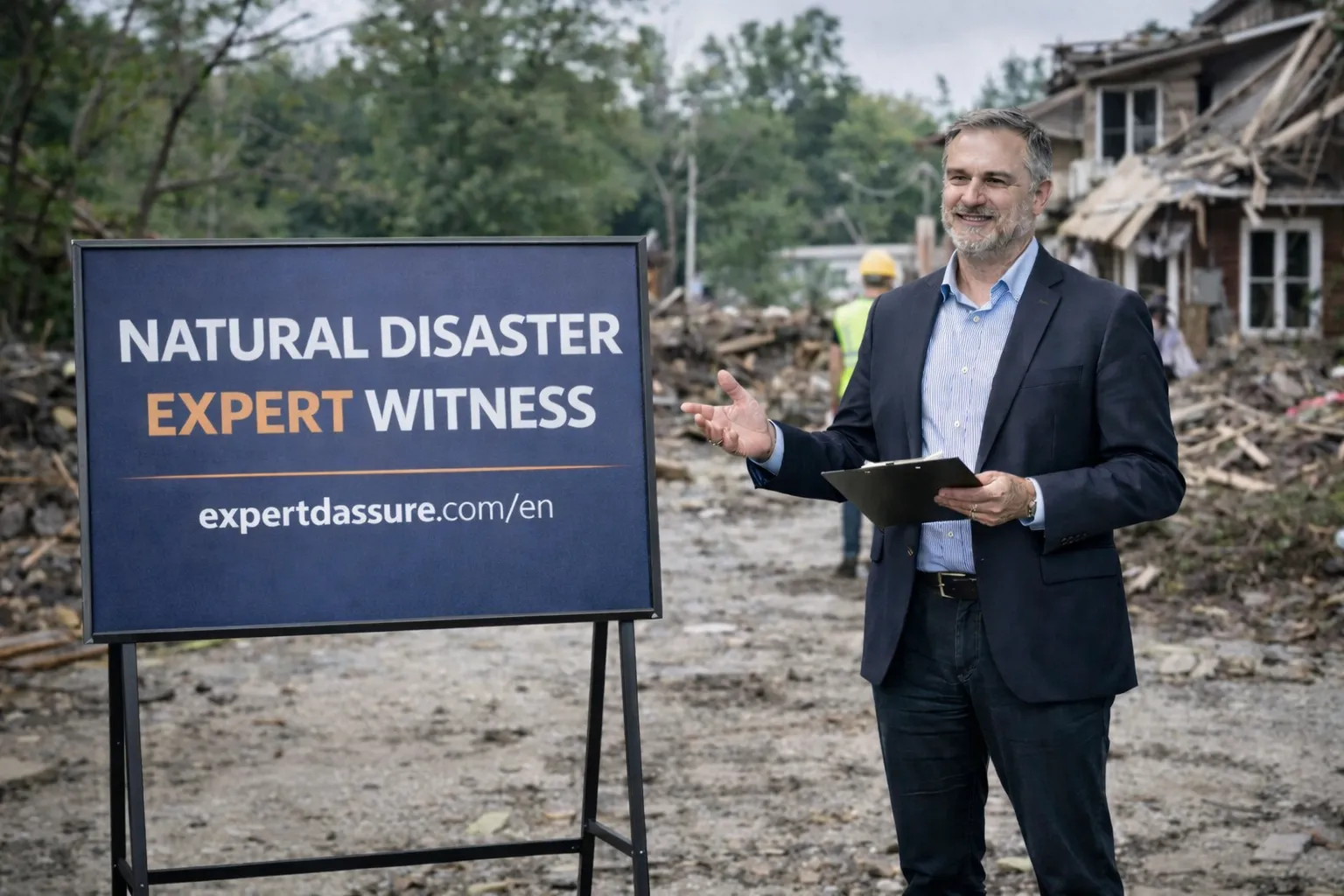
Why catastrophe claims end up needing testimony
Catastrophe events create claims in huge volumes, and insurers respond by sending field adjusters and engineers who may inspect dozens of properties a week. Their reports are often short, standardised and written under time pressure. When the policyholder disagrees, the question is no longer one of goodwill: it becomes a matter of evidence, and the person who can present that evidence clearly in an appraisal hearing, a mediation, an arbitration or a courtroom is the expert witness.
An expert witness differs from a public adjuster or loss assessor. The adjuster or assessor negotiates the claim on your behalf. The expert witness forms an independent opinion on technical questions, sets it out in a written report and, if required, defends it under cross-examination. In England and Wales, an expert instructed in court proceedings owes an overriding duty to the court rather than to the party paying the fee, and US courts test expert opinions for reliability before a jury hears them. That independence is precisely what makes the evidence persuasive.
The causation battle: wind, water, ground and fire
Most disputed disaster claims revolve around causation. A house on the Gulf Coast may show roof damage and flooded ground floors; the homeowner's policy may cover wind while excluding flood, which falls under separate flood cover such as the US National Flood Insurance Program. Deciding which force did which damage, and in what order, can shift the outcome of the claim dramatically.
Similar arguments arise elsewhere: whether cracking was caused by an earthquake or by long-term settlement, whether a basement filled through surface water or through a sewer backup, whether smoke damage at a property near a wildfire is cosmetic or requires replacement of insulation and ductwork. Policies sometimes contain anti-concurrent causation wording that tries to exclude a loss when an excluded peril contributed in any way, so precise technical attribution matters.
- Structural and forensic engineers for collapse, racking, foundation movement and roof failure
- Meteorologists for wind speeds, storm timing and hail size at the specific address
- Hydrologists for flood depth, water entry route and duration of inundation
- Fire and smoke specialists, industrial hygienists and building scientists for contamination
- Quantity surveyors and construction estimators for reinstatement cost
Valuing the loss after prices have surged
Even when liability is accepted, the amount is frequently contested. After a regional catastrophe, labour and materials become scarce and prices rise sharply, sometimes for months. An estimate built on pre-event unit rates will understate the true cost of reinstatement. A costing expert can document local market conditions, contractor availability and the extra cost of complying with current building codes or regulations, where the policy covers such upgrades.
Valuation experts also address depreciation in actual cash value settlements, matching of undamaged materials, business interruption linked to access restrictions, and additional living expenses for families who cannot return home. Each of these items is open to reasonable disagreement, which is why an independent, reasoned figure carries weight.
Appraisal, mediation or litigation
Many US property policies contain an appraisal clause: each side names an appraiser and the two appraisers select an umpire to resolve differences about the amount of loss. Appraisal is usually faster and cheaper than litigation, but in many cases it is limited to the amount of the loss rather than coverage questions. Technical experts often give evidence to the appraisal panel even though the process is less formal than court.
In the United Kingdom, a policyholder who is an individual or small business can usually take a complaint to the Financial Ombudsman Service once the insurer has issued its final response or the deadline for one has passed, and expert reports can support that complaint. Court proceedings remain the route for larger or more complex disputes, and there the expert's report must follow the procedural rules on expert evidence.
Preserving evidence before it disappears
Disaster evidence is perishable. Debris is cleared, mould spreads, temporary repairs cover the original damage and neighbouring properties are rebuilt. An expert who arrives months later can only reconstruct events from photographs and records, so early action is valuable. Policyholders should photograph and video every room and elevation, keep samples of damaged materials where safe, note water lines with a tape measure in the frame and save weather alerts and evacuation notices.
Mitigation duties still apply: you are generally expected to take reasonable steps to prevent further damage. Keep receipts for tarpaulins, pumps, dehumidifiers and emergency boarding, and tell the insurer before discarding significant items unless safety requires otherwise.
Choosing and instructing the right specialist
Look for direct experience with the peril and the building type involved, a track record of written reports that have been tested in appraisal, arbitration or court, and an ability to explain technical matters in plain language. Ask whether the expert has worked mainly for insurers, mainly for policyholders, or both; a balanced history can help credibility. Check for conflicts of interest, particularly when a firm has been retained by your insurer on other claims arising from the same event.
A good letter of instruction sets out the precise questions, the documents provided, the deadline and the fee basis. Experts usually charge hourly or daily rates, with separate fees for site visits, laboratory tests and attendance at hearings. Some homeowner and commercial policies reimburse part of the cost of experts, but this depends on the contract wording, so read it before committing.
What a persuasive disaster report contains
Strong reports state the questions asked, the material reviewed and the inspections carried out, then move logically from observations to conclusions. They address the insurer's expert directly, explaining where and why the analysis differs, and they acknowledge uncertainty rather than overstating it. Photographs, weather data, moisture readings and cost breakdowns should be referenced clearly so that an umpire, ombudsman or judge can follow the reasoning without technical training.
Organisations offering this service
- The Expert Witness Institute (EWI): UK body representing expert witnesses, offering training, membership and professional resources to experts who give evidence in court.
- The Academy of Experts: British professional body for expert witnesses, which has notably issued guidance for experts giving evidence remotely in court proceedings.
- Expert Witness Institute (EWI): UK institute supporting expert witnesses, offering membership grades, a podcast and a professional recognition programme including honorary fellowships.
- Financial Ombudsman Service: Official free dispute resolution service in the United Kingdom, handling complaints from policyholders against insurers, including disputed or rejected insurance claims.
External links provided for information only; check the terms directly with each organisation.
Frequently asked questions
Is a natural disaster expert witness the same as a public adjuster?
No. A public adjuster or loss assessor negotiates the claim for you, while an expert witness provides an independent technical opinion that can be tested in appraisal, arbitration, an ombudsman complaint or court.
When should I bring in an expert after a catastrophe?
As soon as the insurer disputes cause or value, and ideally before repairs remove the evidence. Early inspection is far more reliable than reconstruction from photographs.
Can I use the expert's report if the claim never goes to court?
Yes. Many disputes settle in negotiation or appraisal once the insurer sees a reasoned independent report, which is often the most cost-effective outcome.
Will my policy pay for the expert?
Sometimes partly, depending on the wording and the nature of the cost. Check for clauses on claim preparation costs or professional fees, and confirm with the insurer in writing.
A well-chosen natural disaster expert witness turns a disagreement over impressions into a debate about evidence, which is where policyholders usually fare best. expertdassure.com recommends acting early, preserving everything and defining the expert's questions precisely.