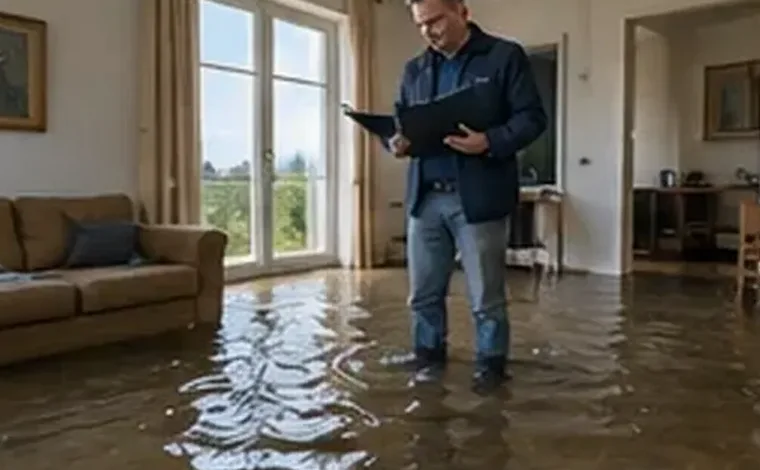
Tasks included in a water claim fee
On a water loss, the public adjuster's fee usually covers a review of the policy's water, mold and exclusion wording, an inspection that traces the path of the water, a repair estimate including tear-out and access costs, review of the mitigation company's invoice and drying logs, a contents list, the proof of loss, and negotiation with the insurer's adjuster.
If the insurer has denied the claim as long-term leakage, the work may also include gathering plumbing and moisture evidence, sometimes with an outside expert. Ask whether such experts are included in the percentage or charged on top.
In condominiums, the adjuster may also need to deal with the association's master policy and its insurer. Ask whether coordination with a second carrier, or with a neighbor's insurer when water came from another unit, is included in the fee.
Indicative fee tiers on water losses
The table sets out an order of magnitude observed in the US market. It is not official, does not reflect any legal schedule and is subject to state caps where they exist. Small water claims attract higher percentages or a minimum fee because inspection, documentation and negotiation take time regardless of the amount.
| Amount recovered (USD) | Indicative fee | Comment |
|---|---|---|
| Up to 15,000 | 15% to 20% or minimum fee | Often more efficient to handle directly |
| 15,001 to 50,000 | 12% to 15% | Kitchen or bathroom leak with tear-out |
| 50,001 to 150,000 | 10% to 12% | Multi-room damage with contents and living expense |
| 150,001 to 500,000 | 8% to 10% | Severe residential or condominium loss |
| 500,001 to 2,000,000 | 5% to 8% | Commercial building or freeze event |
| Over 2,000,000 | Negotiated, often 2% to 5% | Large commercial or multi-unit loss |
Indicative amounts, to be checked with each expert.
State regulation of fees
Public adjuster fees are governed by state law. Texas limits compensation to 10 percent of the settlement; Florida sets caps that differ depending on whether the claim arises from a declared emergency. Other states impose contract form, disclosure and cancellation requirements without a percentage cap. Confirm current rules with your state Department of Insurance.
Bases and methods of calculation
Compare contracts on the full formula, not only the rate.
- Percentage of all insurer payments, including amounts paid directly to the mitigation company
- Percentage only of the increase above the insurer's first written estimate
- Minimum fee, frequently used for small claims
- Flat fee for a defined task, such as reviewing an estimate or preparing a proof of loss
- Hourly fees for outside experts such as plumbers, hygienists or engineers
- Expenses: travel, testing, copies, which should be listed and capped
Mitigation invoices and the fee base
Insurers often pay water mitigation companies directly, sometimes before a public adjuster is involved. Whether the adjuster takes a percentage of that payment should be stated clearly. Many policyholders negotiate to exclude emergency services already approved and paid.
The effort grows with denials based on long-term leakage, mold, disputes over matching flooring or cabinets, condominium coverage splits and claims requiring outside experts. A straightforward burst pipe with prompt mitigation and an insurer that accepts the cause is much simpler. A reasonable firm will reflect this in its percentage or offer a flat fee for limited work.
Does insurance cover the adjuster's cost?
In the US, homeowners and condominium policies generally do not reimburse the policyholder's own adjuster. There is rarely an equivalent of the expert fees guarantee found in some European contracts. Commercial policies may reimburse claim preparation costs for accountants, but water damage claims seldom involve such work.
The fee is therefore normally deducted from the settlement. Weigh it against your deductible, which may be 1,000 to 5,000 dollars or more on many policies, and against any mold sublimit that caps part of the recovery.
When water came from a neighbor's unit or a contractor's mistake, your insurer may recover its payment from the responsible party. Your adjuster's fee is usually not part of that recovery, so it remains your cost even if someone else is ultimately at fault.
Small, medium and large water claims
Leaking dishwasher, 9,000 dollars of damage, 2,500 dollar deductible: the payment would be 6,500 dollars. A 15 percent fee is under 1,000 dollars, but a minimum fee of 1,500 dollars or more would consume a large share. Direct handling is usually more sensible unless the claim is denied.
Burst upstairs supply line, 75,000 dollars: if the insurer offers 48,000 dollars and the adjuster documents the full scope, an increase-only fee of 15 percent on 27,000 dollars would be 4,050 dollars; a 12 percent gross fee on 75,000 dollars would be 9,000 dollars.
Pipe burst in a vacant commercial building during a freeze, 900,000 dollars: negotiated rates of 7 to 10 percent would give 63,000 to 90,000 dollars. Examples are illustrative and do not predict outcomes.
Reading and negotiating the contract
A compliant contract identifies the adjuster and license, the fee and its base, how payment is taken from settlement checks, what happens on cancellation, and any statutory rescission period. Read it at home, not on the doorstep, and compare at least two firms.
Ask each firm to show, in writing, what you would pay if the insurer simply confirmed its current offer and what you would pay if the full claimed amount were obtained. Two numbers make any proposal easy to compare.
- Is the fee charged on amounts paid before signing?
- Who pays for leak detection or mold testing?
- Does the fee apply to released depreciation and living expense payments?
- Is there a minimum fee, and how is it credited?
- Can the rate be reduced if the claim settles quickly?
Unrealistic promises to watch for
Be skeptical of anyone guaranteeing that a long-term leak will be paid, that mold limits do not apply, or that your deductible can be waived. A professional will assess the policy and evidence first, then explain the realistic range of outcomes and what the fee will be in each case.
Organisations offering this service
- Noble Public Adjusting Group: Public adjusting firm operating nationwide across the United States, advocating for policyholders on residential and commercial property insurance claims.
- United Policyholders: US non-profit organisation that informs and supports policyholders after a loss, working alongside the public adjusting profession and its associations.
- NAPIA – National Association of Public Insurance Adjusters: US professional association of public adjusters, founded over 75 years ago, offering a directory to find a member public adjuster near you.
- Adjusters International: US network of public adjusting firms representing policyholders, businesses and public entities in the settlement of significant property insurance claims.
External links provided for information only; check the terms directly with each organisation.
Frequently asked questions
What is a typical minimum fee on a water claim?
It varies by firm and region. Some charge a minimum of a few thousand dollars, which makes very small claims uneconomic. Ask before signing.
Can I hire a public adjuster only after a denial?
Yes. Some firms take on denied claims, sometimes at a higher percentage reflecting the risk and effort involved.
Does the fee apply to the mitigation company's bill?
Only if the contract says so. Many policyholders negotiate to exclude emergency services already paid.
Is the fee negotiable on a small claim?
Yes, fees are contractual. A flat fee for an estimate review may be a better fit than a percentage.
For water damage, compare the fee with your deductible, any mold sublimit and the realistic additional recovery before deciding. expertdassure.com recommends getting every fee term in writing.