Start with the question, not the directory
Before searching, write down the precise questions in dispute. Is the insurer challenging the cause of damage, the cost of repair, the amount of lost income, the medical condition or the conduct of a professional? Each question points to a different discipline. Many disputes need two or three experts, for example an engineer on cause and a quantity surveyor on cost.
Defining the questions also helps control cost: an expert asked a narrow, clear question produces a focused report, while a vague instruction invites a long and expensive one.
Common specialisms by type of claim
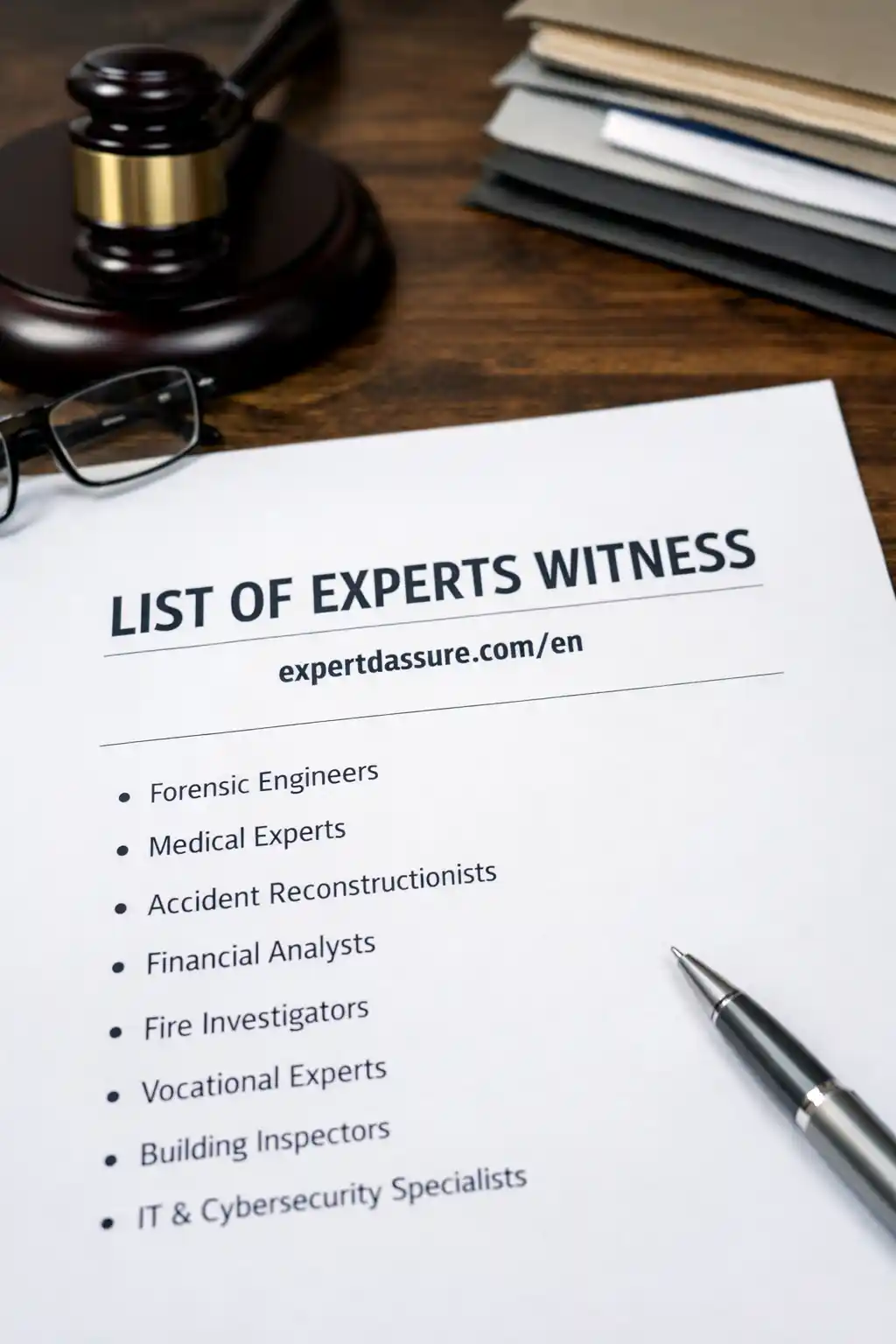
The list below groups the experts most often used in insurance disputes. It is not exhaustive, but it covers the majority of claims that policyholders face.
- Property damage: structural engineers, building surveyors, fire investigators, quantity surveyors
- Natural catastrophes: meteorologists, hydrologists, geotechnical engineers
- Business interruption: forensic accountants, industry specialists
- Personal injury and disability: medical consultants, nurse experts, vocational experts, care experts
- Professional liability: experienced practitioners from the same profession
- Marine, aviation and cargo: surveyors, master mariners, aviation engineers
- Life and health: actuaries, medical underwriters
| Region | Typical sources | Points to check |
|---|---|---|
| United Kingdom | Expert witness bodies, RICS, CILA, engineering institutions, solicitor referrals | Compliance with court rules on expert evidence, testimony history |
| United States | Professional associations, expert directories, attorney referrals | State licensing where relevant, prior admissibility challenges |
| Continental Europe | Court-maintained expert lists, professional chambers | Recognition by local courts, language of proceedings |
| International arbitration | Specialist firms, arbitration practitioners | Experience with expert conferencing and cross-examination |
Where reputable experts are listed
In the United Kingdom, organisations such as the Expert Witness Institute and the Academy of Experts provide directories, training and codes of conduct for experts. Professional bodies keep their own registers: the Royal Institution of Chartered Surveyors for surveyors and valuers, the Chartered Institute of Loss Adjusters for claims professionals, and engineering institutions for chartered engineers.
In the United States, experts are often found through professional associations in their own fields, commercial expert directories, referrals from attorneys and published case law. For policyholder-side claims handling, state-licensed public adjusters and their national association are a starting point, although public adjusters negotiate rather than testify in most cases.
Elsewhere, many civil law countries maintain lists of court-approved experts kept by courts or professional bodies. Those lists are useful indicators of recognised competence, even when a party appoints its own technical adviser.
Checks before you instruct anyone
Verify qualifications and current registration with the relevant professional body. Ask for a CV that lists relevant cases, publications and testimony experience. Search for published judgments mentioning the expert; judicial comments on credibility can be revealing. Ask whether the expert has acted for your insurer or for the opposing party, and whether any current work creates a conflict.
A short introductory call is useful. A good expert asks probing questions, explains limitations honestly and does not promise a particular conclusion before seeing the evidence.
Directories versus personal referrals
Directories are a broad net, but entries are often self-written and some are paid listings. Referrals from lawyers, brokers and loss assessors who have seen an expert under pressure are usually more reliable. Combining both, by drawing a shortlist from directories and then asking practitioners for feedback, tends to give the best result.
Fees, terms and the letter of instruction
Experts typically charge hourly or daily rates, with fixed fees sometimes available for defined reports. Ask for the rate, an estimate for each phase, charges for travel and hearing attendance and cancellation terms. Contingency or success-based fees are generally inappropriate for expert witnesses because they undermine independence, and in some systems they are not permitted.
The letter of instruction should set out the questions, the documents supplied, deadlines and the procedural rules that apply, so that the report is usable in whatever forum the dispute ends up in.
International claims and language
For claims abroad, consider whether you need an expert familiar with local practice, an expert who can give evidence in the language of the proceedings, or both. A lead expert working with local specialists is a common solution. Check that each contributor's qualifications are recognised in the relevant country.
Red flags when shortlisting
Be cautious of experts who claim competence in a very wide range of unrelated fields, who promise a favourable conclusion before reviewing the file, or who cannot provide examples of reports they have written. A long list of cases for one side only is not disqualifying, but it invites questions about independence. Very low quotes can signal inexperience or a report too thin to withstand challenge, while unusually high rates do not guarantee quality.
Equally, consider availability. An excellent expert who cannot inspect the property for three months may be less useful than a capable one who can attend next week, particularly when evidence is deteriorating or repairs cannot wait.
Organisations offering this service
- The Academy of Experts: British professional body for expert witnesses, which has notably issued guidance for experts giving evidence remotely in court proceedings.
- Expert Witness Institute (EWI): UK institute supporting expert witnesses, offering membership grades, a podcast and a professional recognition programme including honorary fellowships.
- The Expert Witness Institute (EWI): UK body representing expert witnesses, offering training, membership and professional resources to experts who give evidence in court.
- Aspray: UK network of loss assessors handling and negotiating insurance claims on behalf of policyholders, notably after fire, flood and escape-of-water damage.
External links provided for information only; check the terms directly with each organisation.
Frequently asked questions
Is there an official worldwide list of expert witnesses?
No. Lists exist by country, profession or organisation, so policyholders usually combine several sources and verify each candidate.
Should I choose the most qualified expert I can find?
Choose the most relevant one. Direct experience of your type of loss and an ability to explain clearly matter more than seniority alone.
Can an expert work on a no-win, no-fee basis?
Generally this is discouraged or prohibited because it compromises independence. Expect hourly or fixed fees.
A good expert witness is found through clear questions, reputable sources and careful checks rather than a single directory. Taking that structured approach saves money and strengthens the policyholder's case.